
Overview
- Overview
-
A mini conference and hands-on workshop on generative AI and large language models in social-science research, including structured extraction and validation workflows.
- Audience
-
This workshop was first designed for social-science scholars, researchers, and students participating in the Ewha Womans University mini conference on AI and machine learning. The materials are generally applicable to students of any level and degree program.
- Teaching
-
-
Ewha Womans University
English and Korean; AI interpretation will be available.
-
Ewha Womans University
Content
Workshop Overview
This mini conference brings scholars together to discuss the integration of generative AI and large language models into social-science research. It considers both the substantive questions these tools make possible and the methodological, ethical, and systemic challenges they introduce.
Program
The program includes a morning panel on AI in social-science research, an afternoon panel on LLM methods and applications, and a two-hour hands-on workshop. Presentations address substantive research, digital polarization, and workflows for turning large text and media corpora into research data.
Hands-on Session
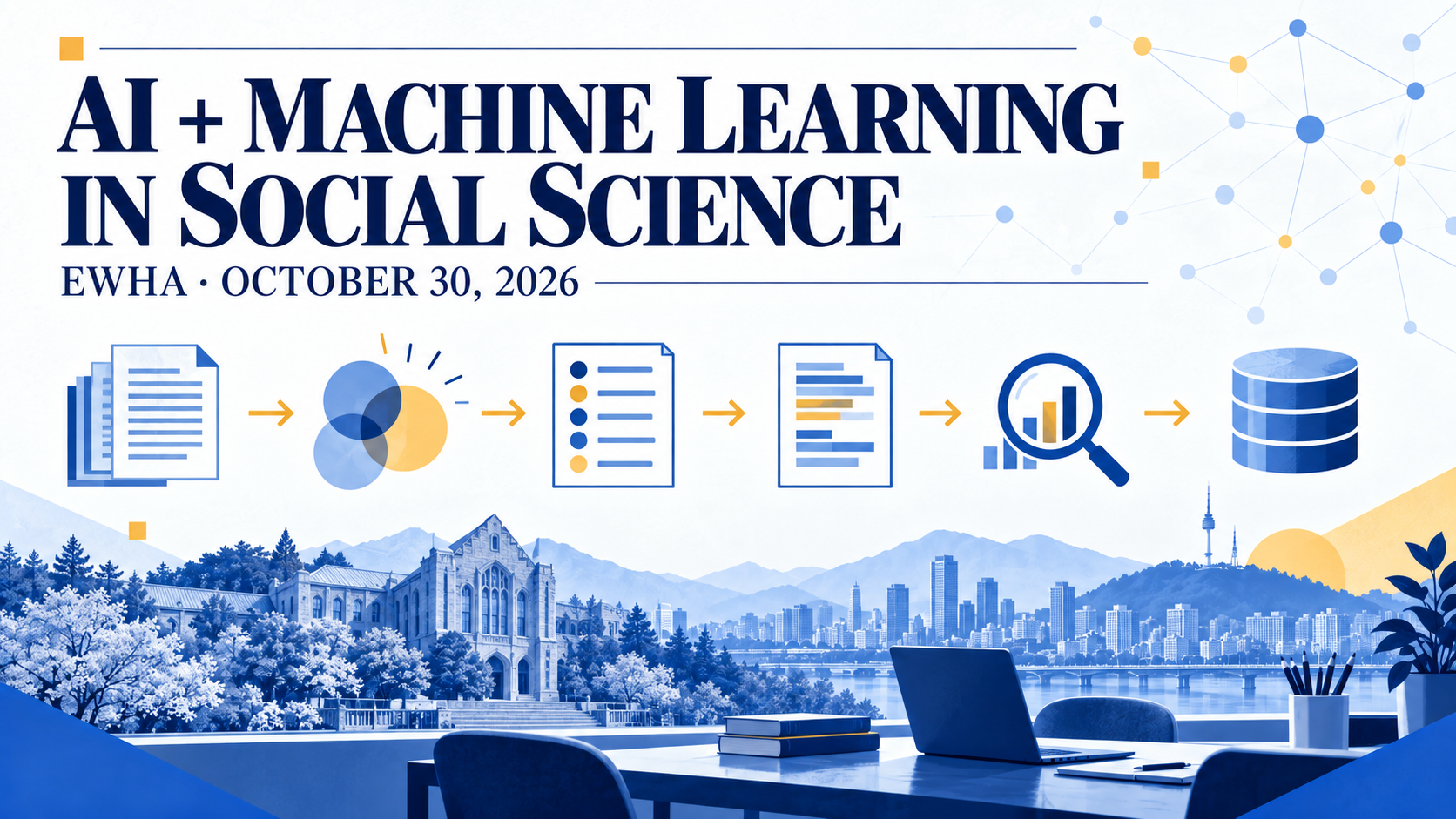
From Corpus to Dataset: AI-Human Workflow for Extracting and Validating Data from Large Text and Media Corpora introduces a six-stage workflow: audit and prepare a corpus; discover candidate concepts; align an exploratory typology with the research design; build and pilot a structured extraction schema; revise, scale, and log the process; and validate and analyze the resulting data. The instructor example uses North Korean enterprise coverage in KCNA and Rodong Sinmun, while participants may work with their own appropriate corpus.
Learning Outcomes
Participants learn to distinguish corpus preparation, retrieval, discovery, classification, extraction, and inference; define a defensible unit of analysis and codebook; design prompts and machine-readable schemas with linked evidence; pilot and revise an extraction workflow; construct an audit, double-coding, agreement, and error-log plan; and produce preliminary summaries and visualizations from the validated data.
Requirements
Participants should bring a laptop and have access to a capable AI assistant. They may bring a small CSV, XLSX, or document corpus, or use an instructor-provided corpus. Confidential, restricted, or sensitive data should be removed unless the participant has approval and an appropriate secure environment.
Resources
- Materials
-
-
Workshop overview and program
Event overview, program, speakers, and schedule.
-
AI Research & Teaching Resource Hub
A crowdsourced directory of AI tools, training, and guidance.
-
AI-Assisted Data Collection Tutorial
The hands-on corpus-to-dataset workflow and workshop exercises.
-
Better, Not More: AI Skills for Experimental Research
Supplementary workshop guidance for deliberate use of AI tools.
-
Workshop overview and program
- Relevant Literature
-
Browse references and supporting literature for this training module in the Organization of Power Lab Zotero library.
Open this training module's Zotero collection