
Steps 3 and 4 leave two scored pools, one from the searches and one from the citations. This step turns them into the corpus. The selection is made by rules the researcher approves, the filing is done by the agent, and collecting PDFs from licensed publisher sites is done by a person with the agent's help. The step ends with an export, so that the analysis in Literature Review II reads fixed files rather than a library that keeps changing.
Section 1Four routes into the corpus
A single score favours one kind of work. The worked example therefore selected by four routes, each with its own rule, over the keyword pool of 19,186 candidates and the citation pool of 3,684 cited works, 3,481 of them distinct from the keyword pool. A work enters the corpus if any route selects it.
| Route | Rule | Works |
|---|---|---|
| Text relevance | combined score of at least 0.85, with an abstract | 486 |
| Seed citation | cited by at least two sources, or by a reference document and one other source | 151 |
| Field influence | top 10% by citations per year, passing a topic check | 89 |
| Discovery convergence | top 10% by discovery signal, passing a topic check | 347 |
| Any route | the Expanded cut | 1,038 |
16_select-articles. The routes overlap, so the union is smaller than the sum.Text relevance finds works that read like the seeds. Seed citation finds the works the seeds rely on, however little metadata they have. Field influence finds widely cited works that the seeds happen not to cite. Discovery convergence finds works that many different searches lead to. Each route alone would leave a recognisable gap.
Section 2Two cuts
Not every work in the corpus needs to be read in full. The researcher confirmed two cuts. The Expanded cut of 1,038 works, confirmed on 13 October 2026, is the corpus read by title and abstract. The PDFs cut, confirmed on 15 October 2026, is the part to be read in full. It held 300 works, 292 chosen by rule and 8 added by the researcher.
Section 3Filing in Zotero
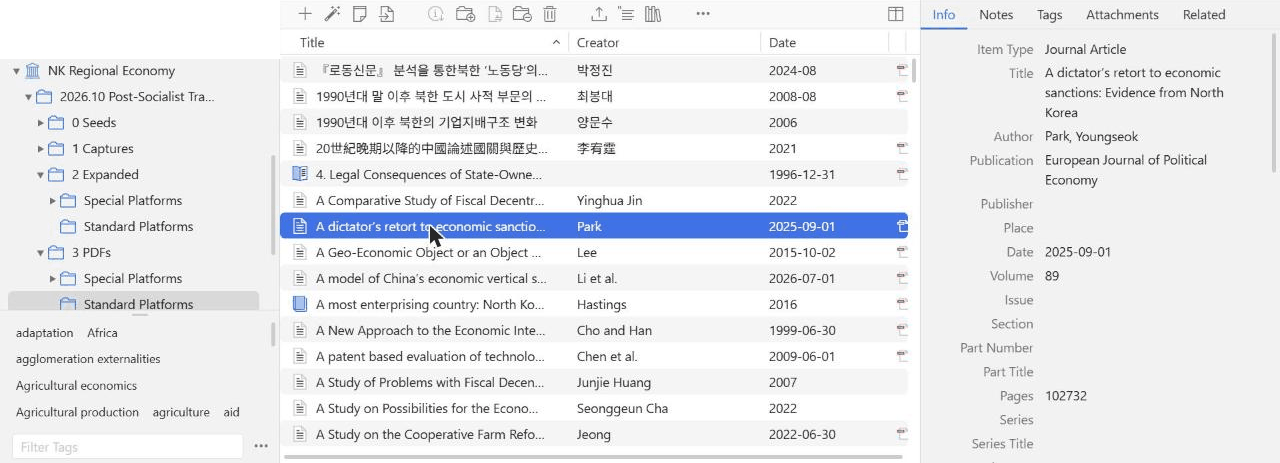
The agent created the Zotero records through the web API, all 1,038 of the Expanded cut in 2 Expanded / Standard Platforms with none failing, and tagged each with the searches that found it. It then filed the PDFs cut in 3 PDFs / Standard Platforms, 298 works once two book reviews had been dropped. Because an item can sit in both collections, nothing is copied.
| Tag | Records |
|---|---|
| China | 399 |
| North Korea | 242 |
| Vietnam | 119 |
Section 4Collecting the PDFs
PDFs come from publisher sites, and most publishers license them to a university rather than to the public. The agent searched each record in the NCCU library catalogue and built a local page of links that go through the library proxy to the publisher's own page for the article. A person signed in to the library opens each link and saves the article with the Zotero Connector, which stores the record, a snapshot of the page and the PDF together.
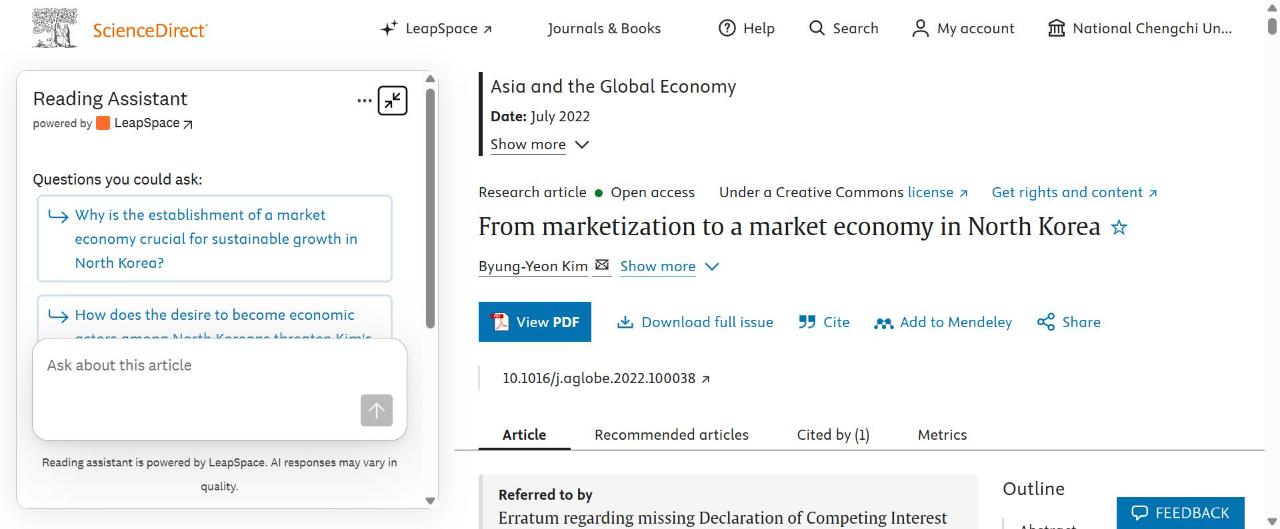
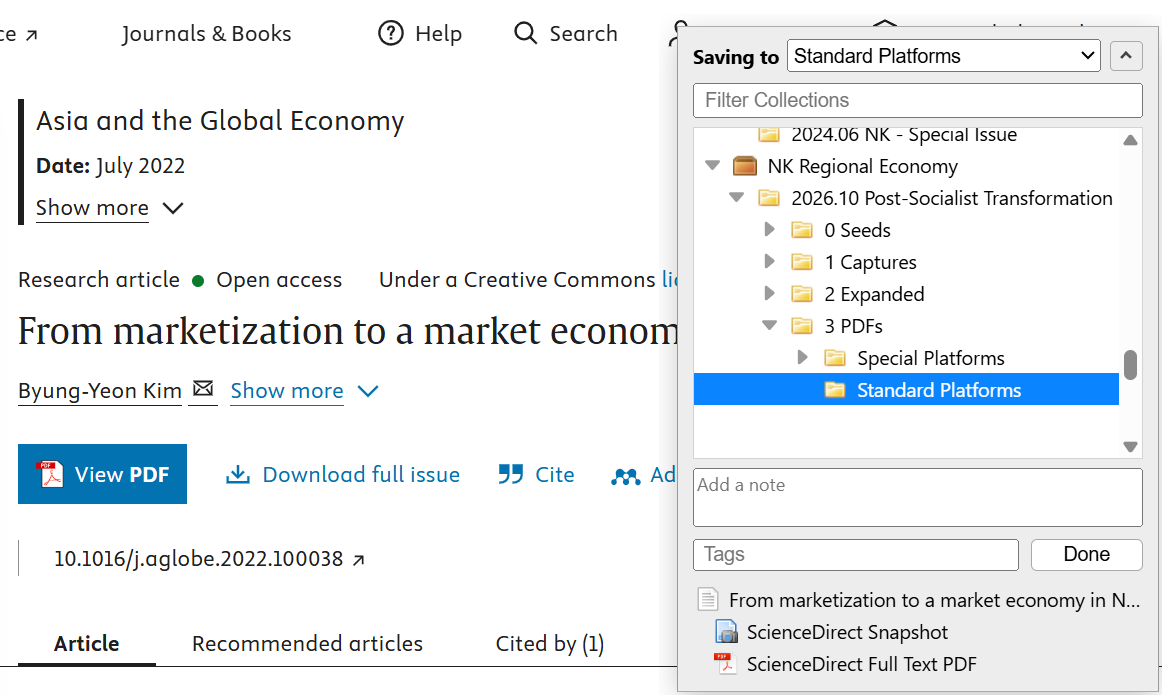
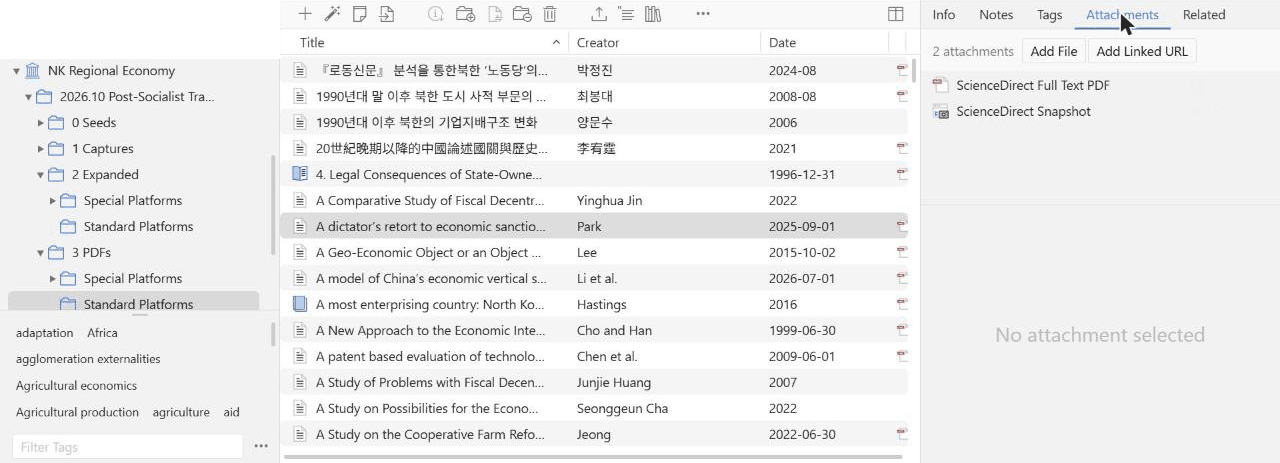
The link page was rebuilt as PDFs came in and records were merged. Its last run, on 12 November 2026, covered the records in 3 PDFs / Standard Platforms that still had no PDF. An English example with real records and inactive links is on the example publisher-links page.
| Outcome | Records |
|---|---|
| Records without a PDF, searched in the NCCU library | 123 |
| Found in the library | 25 |
| with a publisher link | 6 |
| with no publisher link among the online options | 19 |
| Not found in the library | 98 |
40_publisher-links. The six publisher links were on Taylor & Francis (2), Elsevier, Wiley, SAGE and Oxford.Publisher licences generally forbid systematic downloading, and many sites show a verification page to automated browsers. The agent never signs in, never solves a verification page and never downloads in bulk from a licensed site. It prepares the links, and a person with library access does the saving.
Section 5Merging duplicates
Every Connector save creates a new record beside the one the agent filed, and seeds, captures and search results can describe the same work in different ways. The agent audits the collections, finds records that describe the same work, and merges each set into one record. In the worked example one collection audit merged 62 sets of duplicates, and a later pass over the Chinese seeds merged 33 more.
Section 6Exporting the corpus
The export reads the Zotero collections 2 Expanded and 3 PDFs and writes each to a folder of the same name in the review folder. The PDFs folder also receives the PDF files and a plain-text version of each, which is what the analysis reads. Each run is recorded in its own step folder and in a changelog.
| Export | 2 Expanded, works | 3 PDFs, works | 3 PDFs, with a PDF |
|---|---|---|---|
| 24 October 2026 | 1,280 | 458 | 315 |
| 26 October 2026 | 1,270 | 442 | 313 |
| 27 October 2026 (v2.3) | 1,261 | 434 | 309 |
| 11 November 2026 (v2.4) | 1,259 | 433 | 309 |
Literature Review II reads the export of 27 October 2026, version 2.3, with 1,261 works in the expanded corpus and 434 in the PDFs corpus, 309 of them with a full text. Its analysis guide was written from the export of 26 October, with 1,270 and 442 works, and the duplicate merges of 27 October then reduced the counts to those of version 2.3. A further merge produced version 2.4 on 11 November 2026, two works smaller, which does not change the analysis.
- citation_index.csvOne row per work, with creators, date, venue, identifiers, abstract and tags.
- corpus_manifest.csvOne row per work, with its PDF status and main PDF.
- citations.risThe whole collection in RIS, for Zotero, EndNote or Mendeley.
- scores.csvThe scores and selection routes of each work, from Steps 3 to 5.
- pdfs/ and text/The PDF files and a plain-text version of each, with a text manifest.
- corpus_changelog.jsonlOne line per export run.
Terminology
- Selection route
- A rule that admits works to the corpus by one kind of evidence, such as text similarity or citation by the seeds.
- Expanded cut
- The full selected corpus, read by title and abstract.
- PDFs cut
- The part of the corpus chosen for full reading, for which PDFs are collected.
- Library proxy
- A university service that lets a signed-in member open licensed publisher sites from off campus.
- Zotero Connector
- The browser extension that saves the article on the current page, with its PDF, into a chosen Zotero collection.
- Export
- A fixed copy of a Zotero collection as files, recorded with its date, so that an analysis can cite the exact version it read.