
Networks & Organizations Approach
Empirical Framework
Networks & Organizations becomes an empirical framework by recording two kinds of entities—actors and positions—and the ties within and between them. Positions locate offices and roles inside organizations; actors occupy those positions and connect to one another through social relationships. Combined, these records allow the lab to move between actor-centered and organization-centered views of political life.
The framework begins with organization trees, organization rosters, and social networks. Organization trees represent formal relationships among positions. Rosters link actors to the positions they hold over time. Social networks record relationships among actors. Integrating the three reveals how people, offices, and organizations fit together and provides the raw material for organizational measures.
Three Types of Ties
Crossing the two modes—positions and actors—produces three basic types of ties. Position–position ties form organization trees. Position–actor ties form organization rosters. Actor–actor ties form social networks. Each contributes different information, and their integration distinguishes this approach from an actor-only network model.
Organization trees order positions within and across formal hierarchies. Rosters show who occupies those positions at particular times. Social networks show relationships such as kinship, collaboration, or patronage among the actors. The framework uses the observed ties to study systematic linkages among positions and organizations.
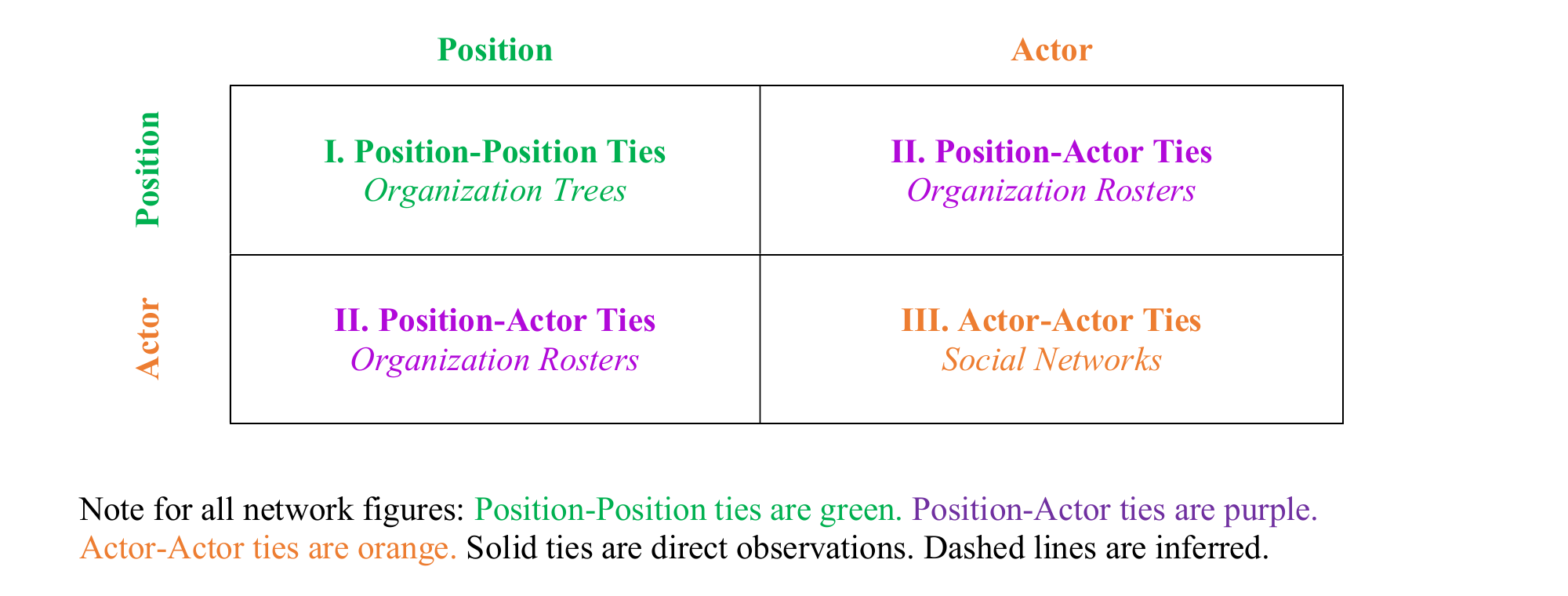
Crossing actor and position modes yields organization trees, organization rosters, and social networks. Green lines denote position–position ties, purple lines position–actor ties, and orange lines actor–actor ties.
Actor-Mediated Position Ties
Many political phenomena are organizational even when the data begins with individuals. Dual office-holding, collusion, career advancement, dynastic succession, and position patronage all connect positions through the actors who occupy them. An actor-centered network alone cannot fully represent these organizational relationships.
The framework therefore inverts the usual actor-centered view. Two positions become connected when a common actor, related actors, or sequential occupants mediate a tie between them. These actor-mediated position ties vary along two dimensions: whether the relation is stationary or sequential, and whether it is mediated by the same actor or by ties between different actors. The resulting typology identifies jointly held positions, coordinated positions, career transitions, and coordinated transitions.
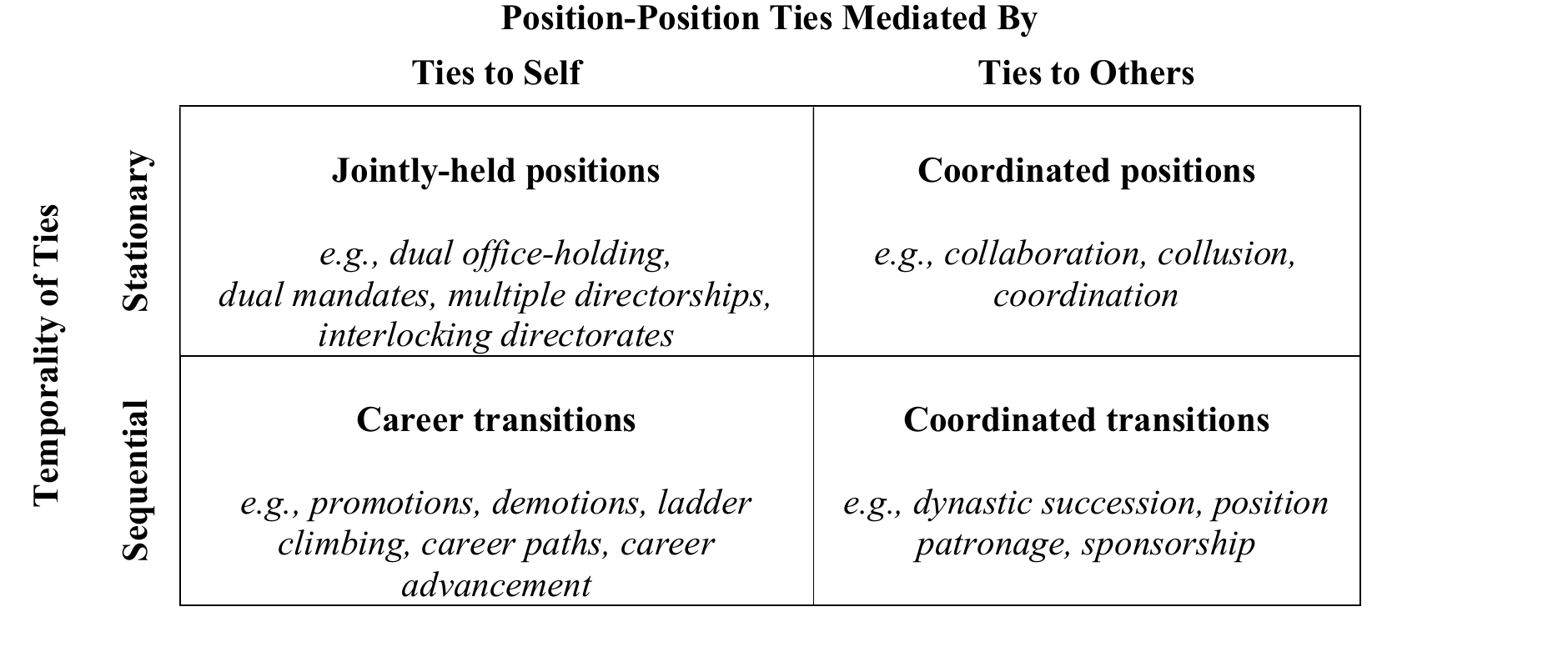
Stationary and sequential ties, mediated by the same actor or by ties among different actors, produce four families of organizational measures.
In the figures that follow, solid lines represent directly observed ties. Dashed lines represent position–position ties inferred from those observations. These inferred ties are empirical measures and potential sites of organizational interaction; they do not, by themselves, establish a substantive process such as collusion.
Jointly Held Positions: Dual Office-Holding
Jointly held positions arise when the same actor occupies two positions at the same time. The illustration shows a single actor serving simultaneously as a Farmer’s Association Chair and County Magistrate. Aggregated across cases and time, these ties can identify how often offices are linked, where linkage is concentrated, and whether it changes administrative or electoral outcomes.
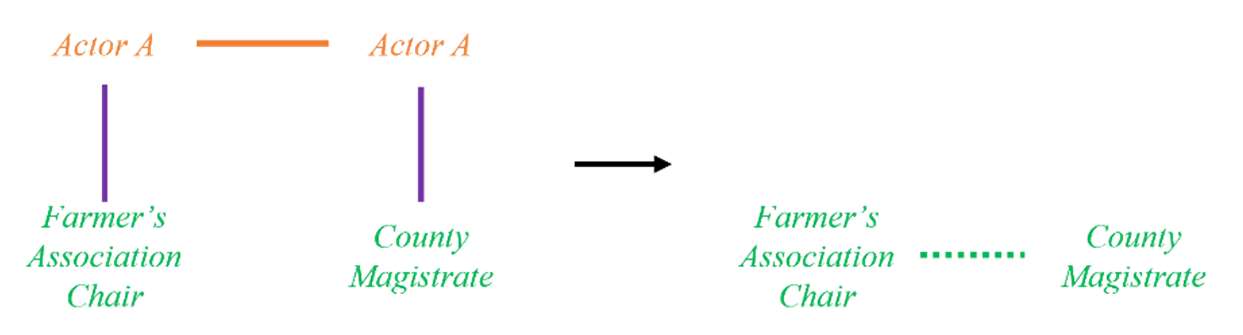
Observed position–actor ties for one person produce an inferred stationary tie between two positions.
Coordinated Positions: Potential Collusion
Coordinated positions arise when actors who are socially connected occupy different positions at the same time. Here, two brothers occupy the Farmer’s Association Chair and County Magistrate offices. Their kinship tie produces an inferred connection between the positions. This identifies a plausible site of coordination or collusion, not proof that collusion occurred.
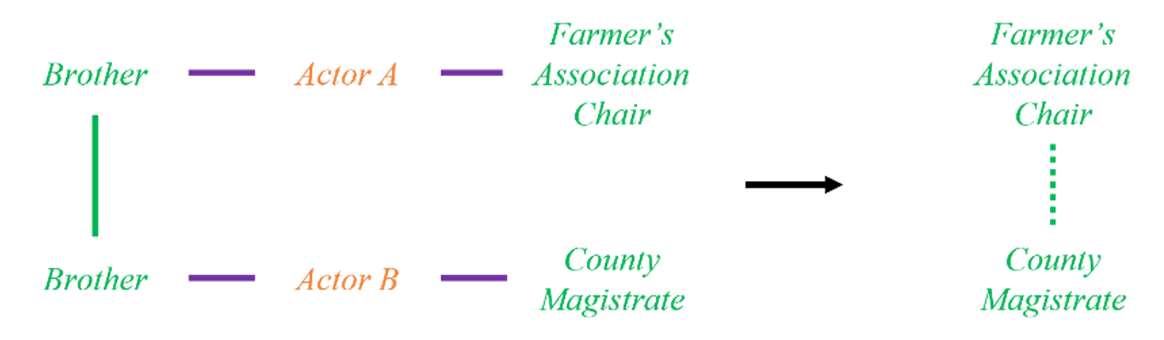
A social tie between different officeholders mediates an inferred connection between their positions.
Career Transitions: Career Advancement
Career transitions arise when the same actor moves between positions over time. The illustration follows an actor from Farmer’s Association Chair at tᵢ to County Magistrate at tᵢ₊₁. Equivalent measures can represent promotions, demotions, career paths, ladder climbing, and the routes through which political personnel advance.
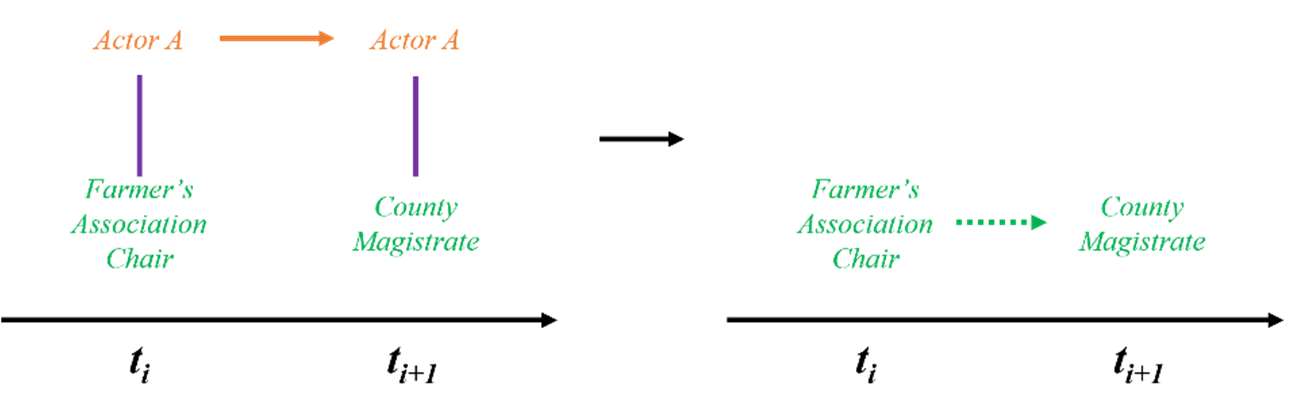
Sequential observations of the same actor produce a directed transition between positions.
Coordinated Transitions: Dynastic Succession and Position Patronage
Coordinated transitions arise when socially connected actors occupy the same or linked positions in sequence. The illustration shows a father followed by a son in the County Magistrate office, producing a measure of dynastic succession. The same logic extends beyond kinship to sponsorship and position patronage, including correlated nomination transitions.
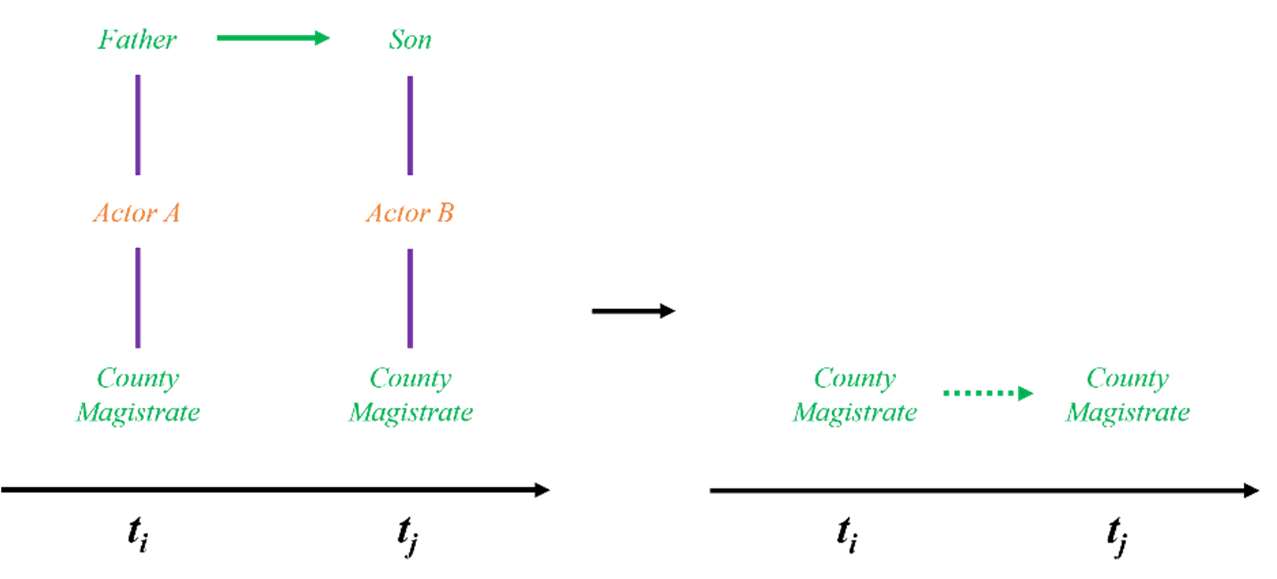
A social tie between sequential officeholders produces an inferred coordinated transition in a position.
Levels of Analysis
Our research often begins by collecting individual-level data, so the first papers produced from a database frequently address career paths, promotions, demotions, joint appointments, and other individual outcomes. These studies also validate the underlying people, position, and time records from which more complex measures are built.
The next goal is to construct organizational measures from those records. Actor-mediated position ties, for example, turn individual appointments, relationships, and transitions into measures of party–government embeddedness, central–regional relations, factions, and networks. At this level, researchers can compare organizational structures and explain organizational and network outcomes.
The longer-term goal is to link organizational data to additional layers of evidence. This makes it possible to examine how variation in political organization—the organization of power—affects governance, development, civic life, public discourse, institutional trust, policy, corruption, and economic outcomes. We are open to collaborating on research touching any of these three levels of analysis, especially work that connects evidence and outcomes across levels.
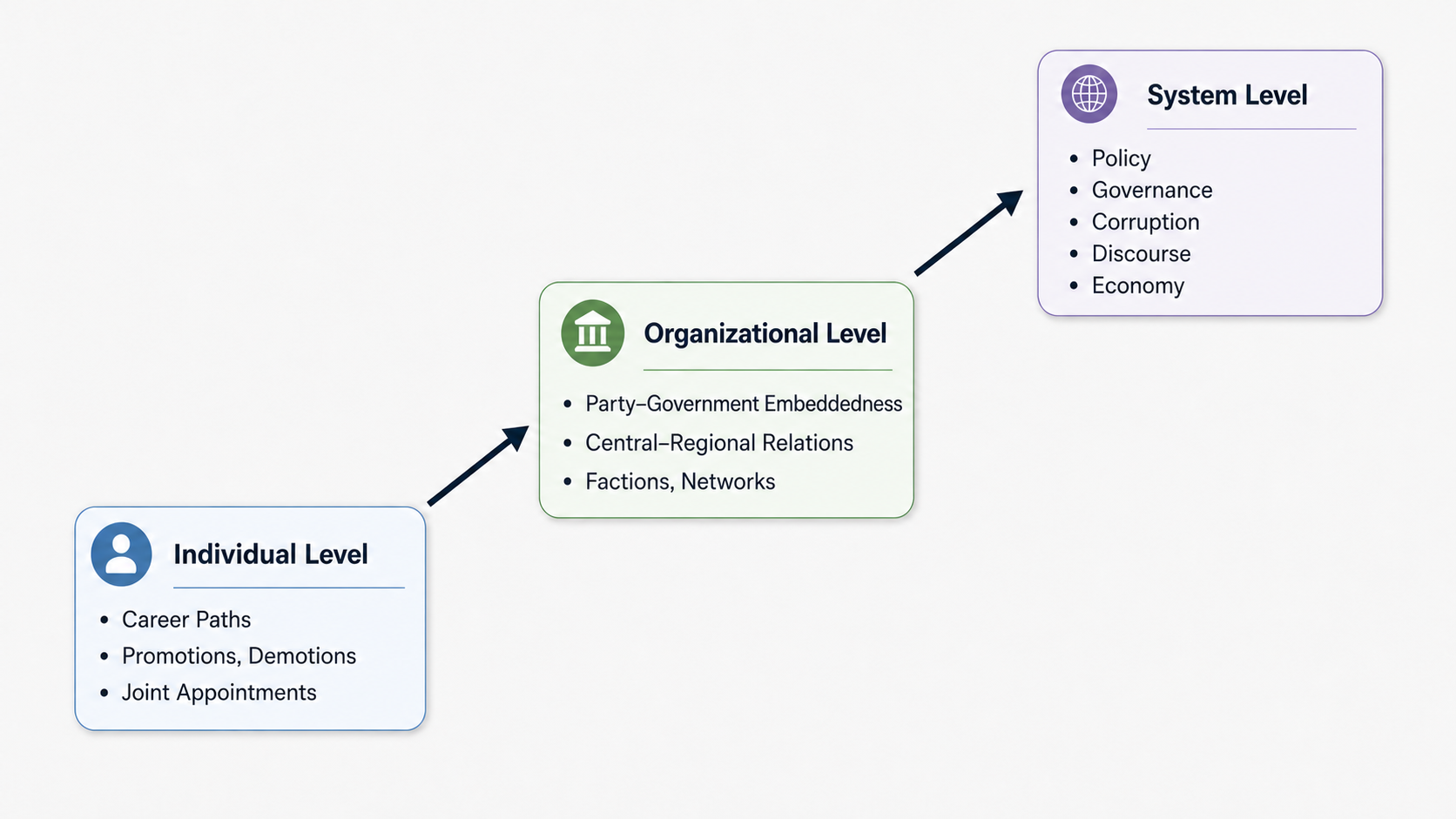
Individual-level records support organizational measures that can be linked to system-level outcomes.
List of Resources
Shared teaching, data, and methodological resources for Networks & Organizations research will be collected here.
Lab Connections
- Databases
- Publications
- 13 publications →
- Research Streams
- Relevant Literature
- See literature for this analytic approach in Zotero.